
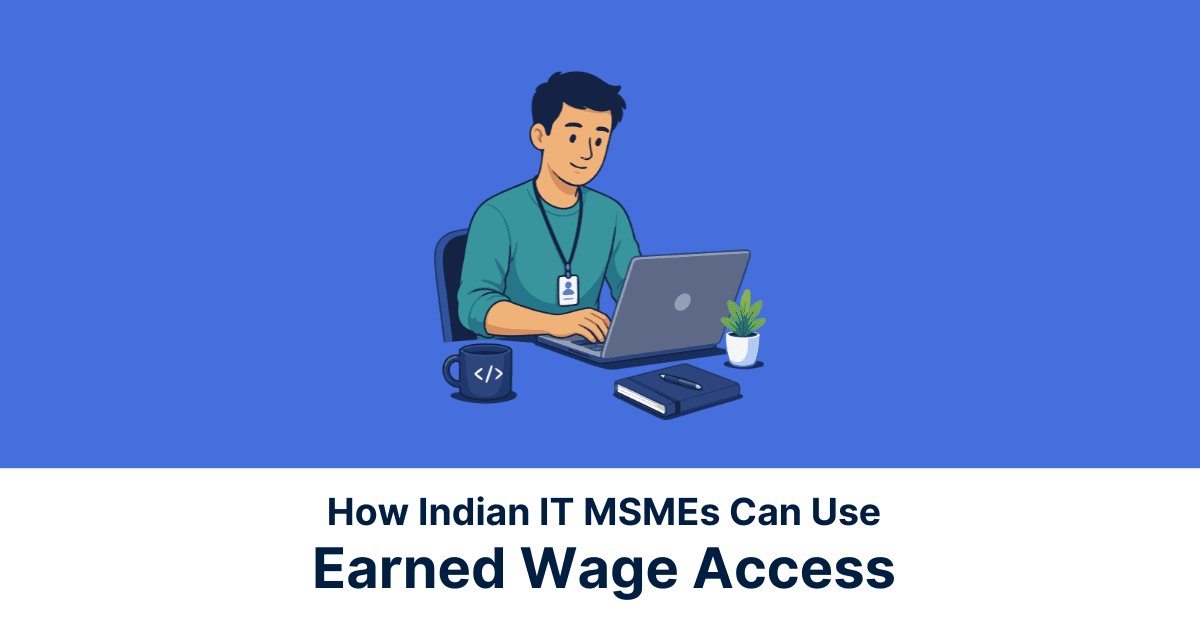
Indian IT MSMEs can use earned wage access (EWA) for IT companies in India to retain developers without matching MNC salary bands. EWA gives employees access to already earned wages between paydays, removing the financial stress that drives 36% of IT moonlighting and accelerates first-year attrition. Rolled out free for the employer, EWA delivers a financial wellness benefit that TCS, Infosys, and Wipro built in-house at zero cost to a 50-person IT firm.
For a 100-person IT services company in Bengaluru or Pune, the talent war is no longer about who pays the highest CTC. It is about who removes financial friction between salary cycles. This guide breaks down how IT MSMEs are using EWA in 2026 to cut attrition, slow moonlighting, and turn financial wellness into a hiring differentiator.
Why are Indian IT MSMEs at a structural disadvantage in talent retention?
Indian IT MSMEs lose developers because they cannot match three things larger firms offer by default:
1. ESOPs
2. International project exposure
3. A globally recognised brand on the resume
India’s tech industry employs 5.80 million people, and the largest firms absorb the lion’s share of mid-level talent through scale and pedigree alone.
The gap isn’t about strategy, it’s built into the math. A 50-person IT firm in Hyderabad can’t send engineers on dollar-paid onsite projects. It doesn’t have the brand name of a global IT services giant on the offer letter. And it usually can’t match the top salaries either, because hiring, training, and setting up a new employee adds another 15% to 25% on top of their base pay, which leaves very little room to pay a premium.
But MSMEs do have advantages that MNCs cannot replicate quickly:
- Speed of decision-making. No three-layer approval for a benefits launch.
- Direct exposure to leadership. Engineers ship code that ships to customers.
- Flexibility on policy. Hybrid and outcome-based work are easier to operationalise.
- Financial wellness benefits. EWA, financial education, and salary-on-demand can be deployed in 48 hours.
The fourth point is the one most MSMEs leave on the table. While Infosys and Wipro have run internal salary advance portals for years, smaller IT firms have historically had no equivalent option, until EWA platforms removed the technical barrier.
What do today’s Indian IT employees actually want (2025/2026 survey data)?
Indian IT employees in 2025/2026 prioritise three things in order:
1. Financial security
2. Work flexibility
3. Clear career growth
EWA addresses the first directly and supports the second by making financial planning location-independent. Recent academic research on Indian IT moonlighting found that monetary benefits and financial pressure positively influence the decision to take a second job, meaning the salary itself is no longer enough; how predictably employees can access that salary matters too.
What is Earned Wage Access and why is it perfect for IT professionals?
Earned wage access (EWA) is a financial wellness benefit that lets employees withdraw a portion of their already earned salary before payday, through a mobile app. It is not a loan. There is no interest. The amount is automatically reconciled at the next payroll cycle.
For IT professionals, EWA fits naturally into how they already manage money:
- They are mobile-first and used to instant digital transactions.
- They evaluate benefits the way they evaluate APIs, by latency, transparency, and cost.
- They understand that real-time access to a resource is more valuable than a periodic batch.
Tech-savvy employees expect their salary to behave like every other digital service in their life: available when needed. EWA delivers that. A backend developer who needs to pay a sudden medical bill on the 18th of the month can access ₹15,000 of their earned salary in minutes, instead of taking a payday loan at 24% interest or asking HR for an advance.
How does EWA help IT MSMEs compete for talent?
6 concrete ways
EWA helps IT MSMEs compete for talent by closing six specific gaps where larger firms have historically had the advantage. Here is what works in 2026:
1. Match the financial wellness perks of larger IT firms — at zero employer cost
Infosys, Wipro, and TCS have run in-house salary advance and financial wellness portals for years, supported by internal HRMS and finance teams. A 100-person IT MSME cannot build that. But Jify gives MSMEs the same capability through a plug and play EWA platform, free for the employer, with a small transaction fee paid by the employee. From the employee’s side, the benefit looks the same- instant access to salary they’ve already earned.
2. Reduce IT attrition during the critical first 6 months
The first 90 to 180 days are the highest-risk window for new IT hires. New joiners often face setup costs, relocation, deposits, equipment they pay for upfront before their first appraisal cycle. EWA bridges this gap by giving day-one access to earned wages. For an IT MSME hiring 20 developers a year, even a 10% reduction in early-stage attrition saves 1-2 full replacement cycles annually.
3. Use EWA as a hiring differentiator in job listings
Adding ‘Earned Wage Access Benefit’ to a job ad, is a concrete financial wellness signal. Unlike vague claims about “great culture” or “competitive benefits.” It tells a candidate that the company has invested in their financial wellbeing in a way they can verify in week one. This works particularly well for mid-level engineers comparing offers from a Tier-1 service firm and a 200-person product MSME.
4. Retain mid-level engineers who moonlight for financial reasons
Industry surveys show that 36% of tech professionals who moonlight say that financial reasons as the primary driver, alongside job security and networking. Academic research on young IT professionals in Delhi NCR confirms that monetary pressure is a key positive predictor of moonlighting behaviour. EWA does not eliminate moonlighting, but it removes a major financial trigger by giving employees mid-cycle access to wages they have already earned.
5. Support WFH and hybrid IT teams with distributed financial needs
Remote IT employees in Tier 2 and Tier 3 cities such as, Coimbatore, Indore, Lucknow, Bhubaneswar often deal with expenses that don’t follow the monthly payroll calendar like school fees, rent, medical bills, EMIs. EWA works through a mobile app regardless of where the employee logs in from, so the benefit reaches every team member equally, whether they’re in Bengaluru or Bhubaneswar.
6. Scale benefits without scaling HR headcount
A 50-person IT firm typically has 1 or 2 HR staff. Adding a benefit that requires manual processing, salary advance approvals, payroll adjustments, adjusting the books at month-end simply isn’t workable.
Jify automates the full EWA workflow: integration with payroll, employee onboarding, withdrawals, and reconciliation. HR admin per EWA user is effectively zero, which means the benefit scales from 30 to 300 employees without a single new hire.
Ready to offer your IT team the same financial wellness benefit MNCs already have? Book a free Jify demo → Free setup. Zero employer cost.
What is the real cost of IT attrition for Indian MSMEs (and what does EWA save)?
The fully loaded cost of replacing one mid-level developer in India in 2026 ranges from ₹3 lakh to ₹8 lakh, including recruitment, ramp-up time, and lost productivity. Indian IT sector attrition averaged 15.1% in 2024 according to Deloitte’s India Talent Outlook 2025, with broader sector estimates putting it as high as 25% and mid-market IT firms typically sit at the upper end of that range.
For a 100-person IT MSME, the math is brutal:
| Cost component | Mid-level dev (₹15 LPA) | Senior dev (₹25 LPA) |
|---|---|---|
| Recruitment fees (1020% of CTC) | ₹1.5L – ₹3L | ₹2.5L – ₹5L |
| Onboarding & ramp-up (3 months at 50% productivity) | ₹1.9L | ₹3.1L |
| Knowledge transfer + project delays | ₹50K – ₹2L | ₹1L – ₹4L |
| Total cost per replacement | ₹3.9L – ₹6.9L | ₹6.6L – ₹12.1L |
If a 100-person IT firm has 20% annual developer attrition, that is 20 replacements per year. Multiply by ₹5L average replacement cost: ₹1 crore annually in pure attrition cost.
Compare this to EWA. Jify’s EWA platform is free for the employer. Even if EWA reduces attrition by just 2 percentage points, from 20% to 18%, the saved cost is roughly ₹10 lakh annually for a 100-person team. The ROI is structural, not theoretical.
Does EWA actually reduce moonlighting among IT employees?
EWA reduces one specific driver of moonlighting, i.e financial pressure, but is not a complete solution to the practice. Survey data on Indian tech employees shows 36% moonlight primarily for financial reasons, while others do so for skill-building, networking, or entrepreneurial reasons, EWA cannot influence.
The honest framing for IT leadership is this:
EWA addresses the financially motivated portion of moonlighting (roughly 1 in 3 cases) by removing the cash-flow trigger that pushes employees to take a second contract. It won’t help with the engineer moonlighting to learn React Native or validate a startup idea. That’s a different retention problem and it needs different levers, like hackathons, or a learning stipend.
What EWA does well in the moonlighting context:
- Removes urgent cash needs that drive emergency side gigs (medical bills, family expenses, deposits).
- Reduces dependence on payday loans and BNPL services that often push employees into longer-term debt cycles, which then increase moonlighting pressure.
- Builds financial trust with the employer, employees who feel the company supports their financial wellbeing report higher engagement scores in HR research.
If 1 in 3 of your IT moonlighters are doing it for money, and EWA removes most of that pressure, the impact on retention and focus is measurable, even if the headline number isn’t zero.
How does Jify’s EWA compare to other IT employee benefits (cost vs impact)?
EWA offers the highest retention impact per rupee of employer cost compared to traditional IT benefits. Here is how the major IT employee benefits stack up for a 100-person IT MSME:
| Benefit | Annual cost per employee (employer) | Adoption rate | Retention impact | Visibility in hiring |
|---|---|---|---|---|
| Earned wage access (Jify) | ₹0 | 40–60% | High | High |
| Group health insurance | ₹8,000 – ₹15,000 | 100% (mandated) | Medium | Medium (table stakes) |
| Annual learning stipend | ₹15,000 – ₹40,000 | 30–50% | Medium-High | Medium |
| Team outings / offsites | ₹5,000 – ₹15,000 | 70–90% | Low-Medium | Low |
| Wellness app subscription | ₹2,000 – ₹5,000 | 10–25% | Low | Low |
Two takeaways for IT founders and HR leaders:
- Health insurance is table stakes, not a differentiator. Every IT firm offers it. It does not move the retention needle in 2026.
- EWA is the only zero-cost, high-impact benefit. It is the closest thing to a free win in the IT benefits stack right now.
This does not mean cutting other benefits. It means adding EWA first before debating whether to expand the learning budget by ₹10,000 per head.
Conclusion: stop competing on salary alone, start competing on financial wellness
Indian IT MSMEs cannot win the talent war on base salary. TCS, Infosys, and Wipro will always have more capital to deploy on top-of-band offers. But they do not have a monopoly on financial wellness and 2026 is the year that benefit becomes the new battleground.
EWA gives IT MSMEs 3 things at once:
1) A hiring differentiator
2) An attrition reducer
3) A moonlighting deterrent
All this at zero employer cost and 48-hour deployment. For a 100-person IT firm losing ₹1 crore a year to developer attrition, even a small reduction in churn pays for the entire benefits program many times over.
The IT companies winning the talent war in 2026 are not the ones matching MNC salaries. They are the ones removing financial friction in the gaps where MNCs are too slow to act.
Stop competing on salary alone. See how IT companies are using Jify → Book a free demo
Frequently Asked Questions — EWA for IT companies in India
Can an IT company with 30 employees use Jify EWA?
Yes. Jify is built for IT firms of all sizes, including 20–50 person teams and early-stage product startups. There is no minimum headcount requirement, no setup fee, and no ongoing employer cost. Onboarding takes under 48 hours once payroll integration is confirmed, and employees activate their accounts through a mobile app with KYC.
Does EWA help prevent moonlighting among IT employees?
EWA reduces one major driver of moonlighting — financial pressure — but does not eliminate it entirely. Industry surveys show 36% of tech moonlighters cite financial reasons. EWA gives employees on-demand access to earned wages, removing the cash-flow trigger that pushes them to take a second contract. It is most effective when combined with engagement and learning programs.
How does EWA integrate with IT payroll systems?
Jify integrates natively with the leading HRMS platforms used by Indian IT firms: Keka, Darwinbox, Greytip (greytHR), ZingHR, and others. Setup typically takes under 48 hours. The integration handles attendance data, salary computation, and reconciliation automatically — so HR teams do not manually process EWA withdrawals.
Is EWA a cost to the IT employer?
No. Jify’s EWA model is free for employers. There is no setup fee, no monthly platform fee, and no per-employee charge. A small per-transaction fee is paid by the employee only when they choose to withdraw earned wages early. Employers get the benefit visibility without taking on a new line item in the HR budget.
Can remote and WFH IT employees use EWA?
Yes. Jify’s EWA platform is mobile-first and works across India regardless of where employees are based — Bengaluru, Coimbatore, Lucknow, or anywhere else. Withdrawals are processed via UPI and bank transfer, both of which work nationally. This makes EWA particularly useful for IT firms running hybrid or fully remote teams across Tier 1, 2, and 3 cities.
Will offering EWA replace the need for salary hikes?
No. EWA complements salary, it does not replace it. It improves financial wellness between pay cycles, which is a different problem from absolute compensation level. IT firms should still benchmark base salary against the market and offer appraisal cycles. EWA reduces attrition independently of salary level by removing mid-cycle financial stress.
Related Jify reading
- Earned Wage Access for Contractors & Freelancers in India
- Myths about earned wage access
- How Small Businesses Can Benefit from EWA
*Disclaimer:
The information contained herein is not intended to be a source of advice concerning the material presented, and the information contained in this article does not constitute financial advice. The ideas presented in the article should not be used without first assessing your financial situation or without consulting a financial professional.