
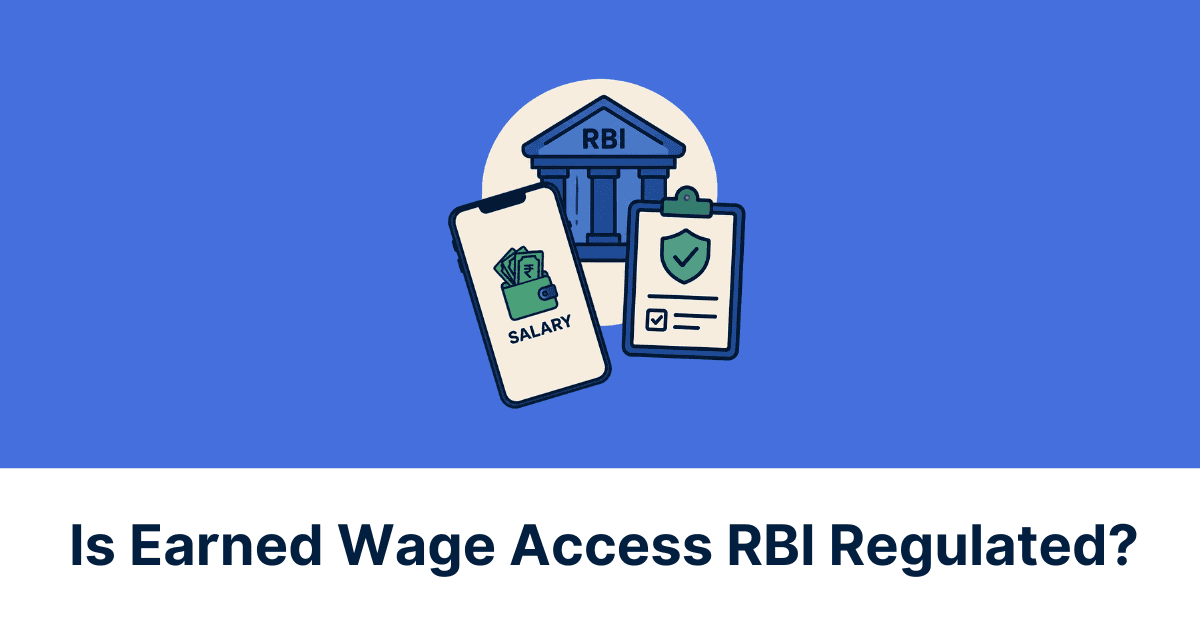
Compliance is the single largest objection HR teams raise when evaluating earned wage access in India. Is EWA legal? Is it regulated by the RBI? Does the employer take on liability if something goes wrong under the new Labour Codes? Those questions have kept many HR leaders from moving forward on EWA regulations in India. And until recently, the answers weren’t easy to find in one place.
The short answer is that EWA is legal in India, well within existing regulatory frameworks, and, when structured correctly, it carries minimal compliance burden for the employer. The nuance is that not all EWA products are structured the same way, so the regulatory
framework that applies depends on whether the product is a pure payroll arrangement or an NBFC-disbursed credit product.
This article is written for HR decision-makers, CFOs, and compliance officers evaluating EWA. It covers the legal position of EWA in India, the five frameworks that apply, what the new Labour Codes 2026 change, what employer compliance actually looks like in practice, and how to evaluate any EWA provider against a compliance checklist.
What Is Earned Wage Access? (Quick Primer)
Earned wage access (EWA) is a benefit that lets employees access wages they have already earned before the scheduled payday. It is not a loan. There is no borrowing, no interest, and no credit check involved. When an employee accesses ₹8,000 mid-cycle through EWA, that amount is simply advanced against wages they’ve already worked for, and deducted from their next payslip through the standard payroll process.
Two things distinguish EWA from a traditional salary advance or payday loan. First, the money accessed is wages already earned, not future wages borrowed. Second, repayment happens automatically through payroll deduction on the next pay date, so there’s no separate collection process, no EMI, and no impact on the employee’s credit score.
This distinction is legally significant and shapes the entire compliance conversation. If you’re new to the concept, our guide on what earned wage access is covers the basics in more detail, and our article on the common myths about EWA addresses the objections that come up most often. This article focuses on the regulatory and legal position.
Is Earned Wage Access Regulated by the RBI in India?
Pure EWA, where employees access already-accrued wages, deducted at payroll, is not classified as a lending product under Indian regulation. It sits within the employer-employee payroll relationship, governed by the Code on Wages rather than by the RBI. However, when a product is structured as an NBFC-disbursed salary advance with interest or a formal credit contract, the RBI’s Digital Lending Directions, 2025 apply. The distinction turns on the product structure, not the marketing label.
This matters because the two structures carry different obligations. A pure EWA product operating as a payroll deduction arrangement does not require RBI registration and is not subject to the Digital Lending Directions. An NBFC-disbursed salary advance, by contrast, is a lending product. The NBFC must be RBI-registered, and the Digital Lending Directions govern how the product is designed, disclosed, and serviced.
The regulatory picture is still evolving. The RBI has shown interest in issuing EWA-specific guidance, and industry bodies have advocated for a clearer framework. As of July 2026, no dedicated EWA regulation exists, so providers work within the existing frameworks summarised in the next section.
The Core Distinction: EWA vs. Salary Advance Loans
Jify offers both structures: pure EWA for wages already earned, and salary advance products routed through RBI-registered NBFC partners for cases where employees need more than they’ve accrued.
Both are handled compliantly, but they sit under different regulatory frameworks.
| Feature | Pure EWA (Employer Payroll Model) | Salary Advance (NBFC Credit Model) |
| RBI classification | Not a lending product | Regulated lending product |
| Governing framework | Code on Wages, payroll law | RBI Digital Lending Directions, 2025 |
| Interest charged | None | Applies as per NBFC terms |
| Credit check | Not required | Required |
| Repayment method | Automatic payroll deduction | As per NBFC contract |
| Credit score impact | None | Reported to CICs |
| Employee-side fee | Small per-transaction fee only | As per NBFC disclosure |
The two products serve different needs. Pure EWA covers the mid-cycle liquidity gap for wages already earned. NBFC-disbursed salary advances cover larger, planned expenses where the employee needs credit against future income. Employers using Jify get both options through a single integration, without having to onboard separate vendors for each.
The Legal Framework Governing EWA in India (2026)
Five frameworks apply to earned wage access in India as of 2026.
None was written for EWA specifically, but together they define what compliant EWA looks like. Employers evaluating a provider should understand where each framework applies and what it requires.
- RBI Digital Lending Directions, 2025: Issued May 8, 2025, these replaced the earlier 2022 Guidelines and consolidated India’s digital lending regulatory framework. They apply to any NBFC-disbursed credit product, including salary advance loans, but not pure EWA.
Requirements cover borrower disclosures, Key Fact Statements, cooling-off periods, grievance redressal, and mandatory reporting of digital lending apps to the RBI’s CIMS portal. - Digital Personal Data Protection Act, 2023: The DPDP Act governs how EWA providers collect, store, and process employee data. Any provider handling salary, attendance, or Aadhaar data is subject to consent, purpose limitation, and data localisation obligations.
Employee data should be stored in India, encrypted in transit and at rest, and accessible only for the purposes disclosed at consent. - Payment and Settlement Systems Act, 2007. This governs the movement of funds through payment channels. EWA fund transfers to employee bank accounts flow through RBI-authorised payment systems like IMPS, NEFT, or UPI, meaning the underlying transaction rails are already RBI-regulated regardless of the product wrapper.
- Code on Wages, 2019 (in force from November 21, 2025). This is the primary framework for pure EWA. It consolidates four earlier wage-related statutes, introduces a uniform definition of ‘wages’, and mandates timely payment. EWA aligns with the Code’s objective; it accelerates access to wages already earned rather than deferring or withholding them.
- Companies Act and employer-employee payroll law. Standard employment law governs the underlying employer-employee relationship, including payroll deduction authorisations.
A compliant EWA setup relies on clear consent language in employment agreements or standalone opt-in forms; most reputable providers handle this as part of onboarding.
How the New Labour Codes 2026 Affect EWA
India’s four Labour Codes came into force on November 21, 2025, with full operational rollout expected by April 1, 2026 as central and state rules are notified.
Two changes matter directly for EWA.
- First, the Code on Wages introduces a uniform definition of ‘wages’:
With the 50% basic pay rule, which mandates that basic wages must form at least 50% of an employee’s total compensation. This changes how accrued wages are calculated mid-cycle, since the base against which EWA accrues shifts under the new definition. EWA providers with rule engines built for the old wage structure need to update their accrual logic; providers built for the new definition don’t. - Second, the Codes tighten timelines for full-and-final settlement to two working days from the day of cessation. EWA is unaffected here; accessed amounts sit inside the normal monthly payroll cycle and are deducted automatically, not paid out as a separate exit-time obligation.
What Compliance Actually Means for Employers Offering EWA
The compliance burden on an employer offering EWA through a reputable provider is minimal. The regulatory obligations attach to the provider and its NBFC partners, not to the employer. The employer’s role is limited to standard payroll integration and clear communication with employees.
Practically, employer obligations fall into three areas.
- Vendor due diligence: The employer is responsible for choosing an EWA provider that meets applicable compliance standards. This means the provider’s NBFC partners should be RBI-registered (verifiable on the RBI website).
The platform should hold ISO 27001 certification, and the provider should have a documented grievance redressal mechanism. The compliance checklist further down in this article covers the full set. - Payroll deduction disclosure: Employees accessing EWA authorise a deduction against their next payslip. Most reputable EWA providers handle this through an in-app consent flow during employee onboarding, so no separate contract amendment is typically required.
Where employment agreements are being newly issued, adding a standard payroll deduction clause is straightforward. - Employee data consent: Under the DPDP Act, employees must consent to the sharing of salary, attendance, and bank details with the EWA provider. Again, this is generally handled through the provider’s onboarding flow; the employer’s role is to inform employees that the benefit is being offered and to link them to the provider’s app.
Beyond these three, there is no separate regulatory filing, licence, or reporting the employer needs to complete to offer EWA. And smaller businesses evaluating EWA can find a size-specific breakdown of costs, ROI, and setup in our guide to affordable EWA for SMEs in India.
→ See how Jify handles compliance end-to-end. Book a free demo.
How Jify Ensures End-to-End Compliance
Jify’s compliance stack is built to satisfy each of the 5 frameworks listed above, without the employer having to piece it together.
The points below reflect Jify’s current compliance posture, as disclosed in its public documentation.
- RBI-registered NBFC partners: Salary advance products routed through Jify are disbursed by NBFCs listed in the RBI’s public NBFC directory.
NDX P2P Private Limited, K.M. Global Credit Pvt. Ltd., and Whizdm Finance Private Limited. Jify itself operates as a Loan Service Provider (LSP) on their behalf under the Digital Lending Directions, 2025. Details are published at jify.co/nbfc-partners/. - ISO 27001:2013 certification: Jify is certified for information security management, covering how employee salary, attendance, and identity data are handled across the platform.
- VAPT every six months: Vulnerability Assessment and Penetration Testing is conducted twice a year by Appknox, a CERT-In empanelled security vendor. This exceeds the annual cadence typical in Indian fintech.
- DPDP Act compliance: Employee data is stored and processed within India. Data is encrypted in transit and at rest. The Jify app does not access employee photos, contacts, or media files, a common pain point with less-mature EWA apps.
- Grievance redressal: A dedicated grievance officer and escalation channel are published, meeting the Digital Lending Directions’ requirement for a visible complaint mechanism.
- Labour Code-compliant payroll model: Jify’s rule engine has been updated for the new 50% basic wage definition, so accrued wage calculations align with the Code on Wages under the 2026 rollout.
Full documentation of each element is available on request during vendor evaluation.
Employer Compliance Checklist: Before You Deploy EWA
Use this eight-point checklist to evaluate any EWA provider against the compliance frameworks that apply in India. It is written to be provider-agnostic; Jify meets all eight, but any compliant provider should.
- NBFC partner is RBI-registered. Ask for the legal names of the NBFC partners and verify each on the RBI’s public NBFC directory (rbi.org.in). Providers offering credit products without an RBI-registered partner should be treated with caution.
- ISO 27001 certified. Ask for the certificate and check the scope; it should cover the specific systems handling employee data, not a narrower business function.
- VAPT conducted by a CERT-In empanelled vendor. Ask for the frequency and the vendor’s name. Annual is acceptable; every six months is stronger.
- DPDP Act compliant. Employee data stored within India, encrypted at rest and in transit, with a documented consent flow. Ask where the primary and backup data centres are located.
- Clear employee consent and KYC process. The provider’s onboarding flow should handle DPDP consent and KYC without pushing the burden onto the employer’s HR team.
- Grievance redressal mechanism. A named grievance officer and a documented escalation process, visible on the provider’s website, not just buried in a help article.
- Payroll deduction model. The primary product should operate through payroll deduction, not through separate loan repayment collections that create administrative overhead for the employer.
- Labour Code 2026 wage calculation compliance. The provider’s rule engine should reflect the 50% basic wage rule under the new Code on Wages.
Compliance Confidence Is a Competitive Advantage
For most HR teams, EWA compliance has been framed as a risk to manage. The more accurate framing in 2026 is that a compliant, well-regulated financial benefit is itself a hiring and retention signal.
Employees increasingly evaluate benefits alongside pay, and a provider with a visible compliance stack, RBI-registered NBFC partners, ISO certification, DPDP-aligned data handling, Labour Code-ready payroll logic; is easier to defend to a CFO, a legal team, and a workforce.
The compliance heavy lifting has already been done. What’s left is the choice of provider.
For a fuller view of what a compliant EWA setup delivers across the workforce, see our complete guide to the benefits of earned wage access.
→ Explore how Jify’s compliance stack works for your team
Disclaimer: This article is written for general awareness of HR, finance, and compliance leaders evaluating EWA in India. It reflects the regulatory position as of July 2026 and is not legal advice. Employers should confirm specifics with their own legal counsel before deployment.
Frequently Asked Questions
1. Is earned wage access legal in India?
Yes. Earned wage access is legal in India. In its pure form, where employees access wages they have already earned, and the amount is deducted from their next payday through the normal payroll process.
EWA operates within standard payroll arrangements and is not classified as a lending product. When salary advance products involve NBFC-disbursed credit, they fall under the RBI’s Digital Lending Directions, 2025. Jify operates compliantly within both frameworks.
2. Is Jify approved by the RBI?
Jify itself is not an NBFC and does not require direct RBI registration to offer its pure EWA product. Jify facilitates salary advance products through RBI-registered NBFC partners, NDX P2P Private Limited, K.M. Global Credit Pvt. Ltd., and Whizdm Finance Private Limited- all of which are listed in the RBI’s public NBFC directory. Jify operates as a Loan Service Provider (LSP) on their behalf under the Digital Lending Directions, 2025.
3. Does offering EWA create legal liability for the employer?
Not materially. Employers integrating a compliant EWA platform act as facilitators, not lenders. The employer’s role is limited to deducting the accessed amount from the employee’s next payslip, a standard payroll function.
The provider and its NBFC partners carry the regulatory obligations attached to the product itself. Employers can further reduce exposure by choosing an ISO-certified provider with documented DPDP compliance and a visible grievance mechanism.
4. Do the RBI Digital Lending Directions apply to EWA?
The RBI Digital Lending Directions, 2025 apply when EWA is structured as an NBFC-disbursed credit product. For pure EWA, where employees access already-accrued wages through automatic payroll deduction, with no interest or credit contract, the primary legal framework is the employer-employee payroll arrangement under the Code on Wages, not the Digital Lending Directions. Providers offering both structures should apply the correct framework to each.
5. How does EWA work under India’s new Labour Codes 2026?
EWA is compatible with India’s new Labour Codes, which came into force on November 21, 2025, with operational rollout expected by April 1, 2026. The Code on Wages mandates timely payment of wages, and EWA accelerates access to wages already earned rather than deferring them.
The Code’s 50% basic wage rule changes how accrued wages are calculated, so EWA providers with modern rule engines have updated their accrual logic accordingly.
6. Is employee data safe with Jify?
Jify is ISO 27001:2013 certified and conducts VAPT every six months through Appknox, a CERT-In empanelled security vendor. All employee data is stored and processed within India, encrypted in transit and at rest, in line with the Digital Personal Data Protection Act, 2023. The Jify app does not access employee photos, contacts, or media files. Full details are available in Jify’s privacy policy.
7. Is EWA the same as a payday loan in India?
No. A payday loan is a credit product; the employee borrows money they have not yet earned, with interest and a formal repayment obligation. EWA gives the employee early access to wages they have already earned through their own work. No credit is extended, no interest is charged, and no debt is created in pure EWA. For a fuller comparison, see our article on EWA vs payday loans.
*Disclaimer:
The information contained herein is not intended to be a source of advice concerning the material presented, and the information contained in this article does not constitute investment advice. The ideas presented in the article should not be used without first assessing your financial situation or without consulting a financial professional.